

How Do You Invest in Your Sales Team?
For all the investment organisations pour into product development, marketing and customer experience, one of the most strategically important teams is often left relatively unsupported: enablement of the sales function.
This isn’t about criticism. It’s about perspective.
Sales teams are expected to be commercially astute, technically aware, emotionally intelligent, resilient and strategically disciplined. Often all within the same conversation. Yet the level of structured, ongoing investment in their development rarely matches that expectation.
And that disconnect matters.
Sales Is a Discipline. Not an Accident
Very few people choose sales as their career path through their time in education. Unlike engineering or law where degrees and formal pathways clearly map to a profession, most professionals enter sales after broader business study or through experience. Many fall into it rather than consciously choosing it.
There are academic programmes focused on sales and sales management, but they remain the exception rather than the rule. For the majority, professional sales capability is developed on the job.
That would be fine if organisations treated sales development as a long-term discipline. But too often, investment takes the form of periodic training sessions rather than sustained performance support.
Research from RAIN Group indicates that only around one-third of organisations rate their sales training as highly effective¹. If two-thirds of companies don’t see strong results from their training investment, something is misaligned.
Traditional Training Fails Fast
Even when sales training is well designed, it is usually episodic. A classroom session. A workshop. A video series delivered remotely.
People attend, absorb what they can, and then return to the pressures of pipeline management, customer meetings and internal coordination. Within weeks, much of the structured methodology fades under the weight of daily urgency.
This isn’t unique to sales. Research on learning retention tells us that knowledge from one-off events decays quickly without reinforcement. But in sales, the consequences are immediate. Forgotten frameworks mean missed discovery questions. Superficial product knowledge means weaker positioning. Inconsistent methodology means unpredictable outcomes.
And in complex solution environments, particularly in unified communications, contact centre and customer experience markets, that inconsistency is costly.
The Reality of Modern Sales
Selling today is not transactional. It is complex and cognitive.
A sales person might, within the space of a week:
Engage multiple stakeholders across IT, operations, finance and executive leadership.
Diagnose operational challenges they’ve never personally experienced.
Translate evolving product capabilities into commercial outcomes.
Handle objections rooted in risk, legacy infrastructure or internal politics.
Coordinate internal engineers, architects and vendor partners.
Field technical questions that require both accuracy and confidence.
All while maintaining momentum, forecasting accurately and protecting margin.
That is not a lightweight role. It requires intelligence, empathy, discipline and structure.
Yet industry research consistently shows that sales people spend a surprisingly small proportion of their time actively selling, often around one-third of their working week². The remainder is consumed by administration, internal meetings and searching for information.
That’s not simply a productivity issue. It’s a signal that the support infrastructure around sales has not kept pace with the complexity of the role.
see our ‘Day in the Life’ series for further evidence
Sales Enablement Works, When it is Embedded
There is strong evidence that mature sales enablement functions improve performance. Research from Highspot and CSO Insights (now part of Miller Heiman Group) consistently shows that organisations with structured enablement programmes report higher win rates and stronger quota attainment³ ⁴.
But here’s the nuance: enablement works when it becomes part of the daily operating system, not when it remains a slide deck or an annual training initiative.
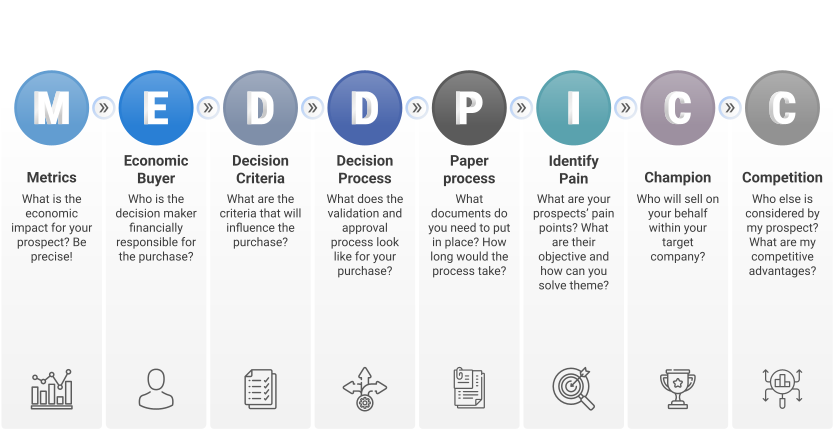
Frameworks like MEDDPICC exist for a reason. In complex, multi-stakeholder deals, structured qualification and disciplined deal management are not optional. They are essential. They provide clarity, common language and commercial rigour.
But a framework on its own does not guarantee execution.
The challenge is not understanding MEDDPICC in theory. The challenge is applying it consistently, in real time, across diverse customer scenarios.

What Investment in Your Sales Team Should Look Like
If training alone is insufficient, and complexity is increasing, the logical next step is not “more courses.” It is better support.
Consider how other high-responsibility professions operate:
Pilots rely on structured checklists and real-time instrumentation.
Surgeons use decision support tools alongside training.
Engineers have documentation and automated feedback embedded into their workflow.
Sales should be no different.
What if, instead of relying on memory and fragmented documents, sales people had structured, contextual guidance available at the point of need? Not as a replacement for skill but as reinforcement. Not as automation but as augmentation.
That is the shift we need to make: from episodic training to embedded performance support.
The Gap Between Expectation and Investment
Organisations expect sales teams to:
Understand complex product portfolios.
Communicate differentiated value.
Navigate political landscapes.
Forecast with precision.
Close high-stakes, multi-year agreements.
Yet the ongoing investment in helping them execute that responsibility is often limited to onboarding and occasional training refreshers.
If sales is the engine of revenue, then it deserves the same operational rigour and tooling that we give to engineering or finance.
The question leaders should ask is simple:
Are we investing in how our sales people perform today or are we assuming that past training is enough?
EngageIQ - A Different Approach
![]()
This is where modern platforms such as EngageIQ come into focus. Not as “another tool,” but as a rethink of how sales capability is supported.
EngageIQ is built on MEDDPICC principles for complex and solution-led sales. It is trained on a company’s own knowledge base: products, services, positioning and commercial models, so that guidance is aligned with reality, not generic theory.
Instead of expecting sales people to remember everything, it provides structured, contextual support in the flow of work.
The outcome is not just time saved, although that matters. It is increased confidence, improved deal discipline and stronger alignment between methodology and execution.
Every sales person can learn and develop structured solution selling skills. Intelligence and potential are not the limiting factors. Support and reinforcement often are.
Reframing the Sales Investment
Sales is not a fallback profession. It is not an accidental career. It is a strategic discipline that converts potential into revenue.
If organisations genuinely want predictable growth, they must treat sales with the same seriousness they apply to product development or customer experience.
That means moving beyond classroom-style training and investing in continuous, contextual performance support.
Because the companies that win in complex markets will not be those with the most slides.
They will be those who equip their sales teams to execute consistently, confidently and intelligently, every single day.
References
RAIN Group, The ROI of Effective Sales Training
https://www.rainsalestraining.com/blog/the-roi-of-effective-sales-training
Salesforce, State of Sales Report
https://www.salesforce.com/resources/research-reports/state-of-sales/
Highspot, Sales Enablement Research & Industry Reports
CSO Insights (Miller Heiman Group), Sales Performance Study
https://www.kornferry.com/capabilities/consulting/sales-effectiveness
Frequently Asked Questions
What is Sales Enablement?
Sales enablement is the structured process of equipping sales teams with the tools, content, training and performance support required to win complex deals consistently.
Why does Traditional Sales Training Fail?
Traditional training is episodic and rarely reinforced in the flow of work. Without contextual reinforcement, retention and behavioural change are limited.
What is MEDDPICC?
MEDDPICC is a structured sales methodology used in complex B2B sales to improve qualification, deal discipline and forecast accuracy.

